Let’s Talk Turkey

I hope you all had a wonderful Thanksgiving holiday and cooked some excellent food along with it. Today we will review my turkey recipe from this year and see how everything went.

Ahh, turkey, the staple of Thanksgiving tables for years and years. It is always controversial as well because the traditionalists will use turkey every year and many others don’t care for turkey because it tends to be dry, and you don’t get a lot of flavor out of it, so they go with other meat options that take its place. I am here today to tell you that I understand both sides of the argument, and provide you with the recipe I used that spoils the argument of it being dry and flavorless.

Like some people, the sides are usually where its at for me, mashed potatoes, sausage stuffing, cranberry sauce (my personal favorite), and so on, but its time that turkey gets out of the bad reputation shadow. This is my 3rd attempt at a turkey for Thanksgiving and I was starting to be convinced that there isn’t anything that can be done to save it, and I was going to try something else if I had the same problem this year. I decided that since I was going to give it one more shot, I should really try, so I did something this time that I had never done before; I brined it.

I ordered a 5 gallon food-safe bucket on the platform that shares its name with a large South American river and also got some brine bags that fit with 5 gallon buckets, and perfected my plan. I was originally going to spatchcock it this year because its fun to say, but I prefer to cook my birds whole, so that’s what I did. I did a 48 hour brine and I will share the recipe below because it was a really good brine, and its worth sharing. We did our family Thanksgiving on Saturday this year because it worked out better. Since we were doing Saturday, I pulled my 13 pound turkey out of the freezer the Sunday before. It only needs 3-4 days at that weight to fully defrost in the fridge, but since I was doing the brine, I needed the extra time.

I was asked by a friend what does brining do, so I figure now would be a good time to explain that. A wet brine is essentially a seasoned bath for a piece of meat that can last as little as 2 hours, or as long as you are willing to let it sit, that being said, anything longer than 48 hours and you run the risk of water logging the meat. The salt in the brines help equalize the salt that is already in the meat, and it helps tenderize as well. Other flavors within the brine do help with imparting some extra flavor into the meat as well. Finally, the fact that it is in water helps add extra moisture to the meat as well, so it really helps with leaner meats like turkey, or a pork loin for example. It does go without saying, but I should say it anyway, please make sure if you do brine, that it is in the fridge, it needs that cold temperature to prevent spoilage.

Once Saturday morning came around, I pulled the bucket out of the fridge, took the turkey out of the brine, placed it on a wire rack/ sheet pan combo, and patted the skin dry with paper towels. Patting the skin dry will help with the always desired crispy skin. After it was dry, I placed in back in the fridge uncovered for an hour so that the constant air movement within the fridge helped dry the skin out even further.

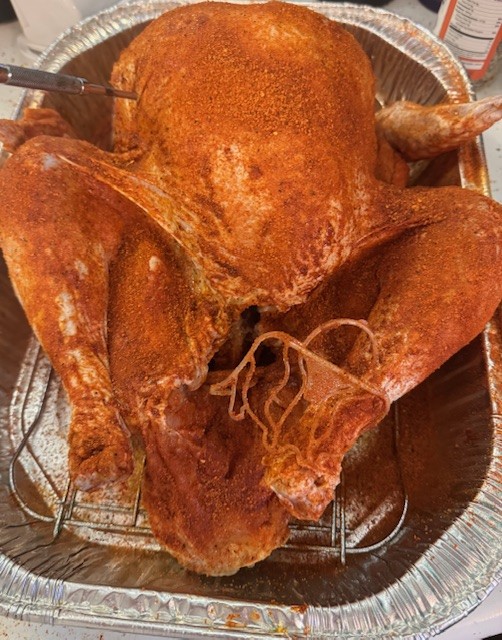
I only wanted to use one rub for the turkey given that the brine had enough salt in it, but I still needed something to help bind the rub to the turkey. Any sort of fat will do, like oils and butter, but I chose to use a duck fat spray. The duck fat spray will also help with the crispy skin, and add some richness to the outside of the turkey. Once the duck fat was all over the bird, I applied a very good layer of my Lovely Jubbly BBQ And Then Some rub to the entire outside of the turkey, as seen below. You can also see my meat probe in the breast there. This turkey came with one of those pop-up temperature thermometers, I hate them, so I took it out and placed my own probe in there instead.

I cooked the turkey on my Pit Boss Sportsman 1100 pellet grill and I set it up to cook at 300 degrees with my favorite Lumber Jack Competition Blend pellets. I also had a fully cooked turkey breast as well that I cooked along with this turkey, but since it was fully cooked already, I was just warming it through, so I am not going to focus on that one much since it was just to supplement meat. An hour into the cook, I took my duck fat spray can and resprayed the outside of the turkey and I also spun the turkey around so the other side of it would be exposed to more heat, and cook more evenly. Once the internal temp of the breast was about 150, I went and check on the bird and I was very happy with the color, so at that point, I added some chicken broth to the aluminum pan and wrapped it in foil until it was done. At 300 degrees, I expected a 13 pound turkey to cook at about 15-18 minutes per pound, or about 3-3.5 hours, but surprisingly it was done in 2.5 hours. I pulled the bird out and let it rest in the foil and under a towel until the other breast was done.

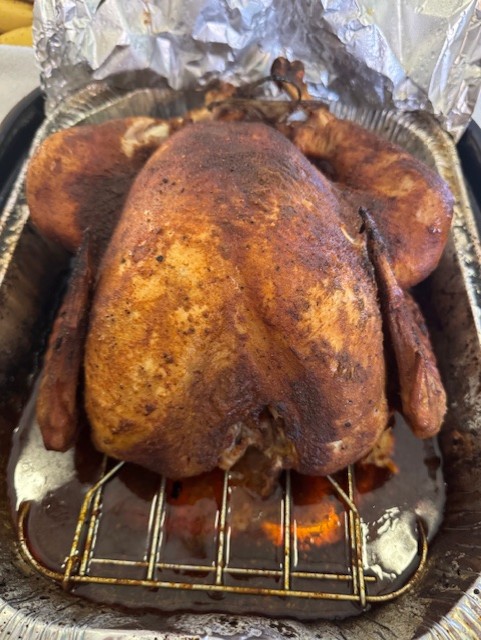
In review, this was my 3rd attempt at smoking a Thanksgiving turkey, and if it didn’t come out as well, it probably would have been my last. I am pleased to say that not only was this bird pretty, but it was also the juiciest and most flavorful turkey I have ever had. It was an overwhelming success, the only down side was that I lost the crispy skin because we had a 30ish minute drive to where we were eating, but that doesn’t change the flavor and the look of it.

Brine Ingredients:

  • 1, 5 gallon FOOD SAFE bucket
  • 5 gallon brine bag
  • 1.5 cups of kosher salt
  • 1/3 cup brown sugar
  • 1/4 cup of Worcestershire Sauce
  • 3 table spoons minced garlic
  • 1 tablespoon ground black pepper

Turkey Ingredients:

  • 1, 13 pound turkey
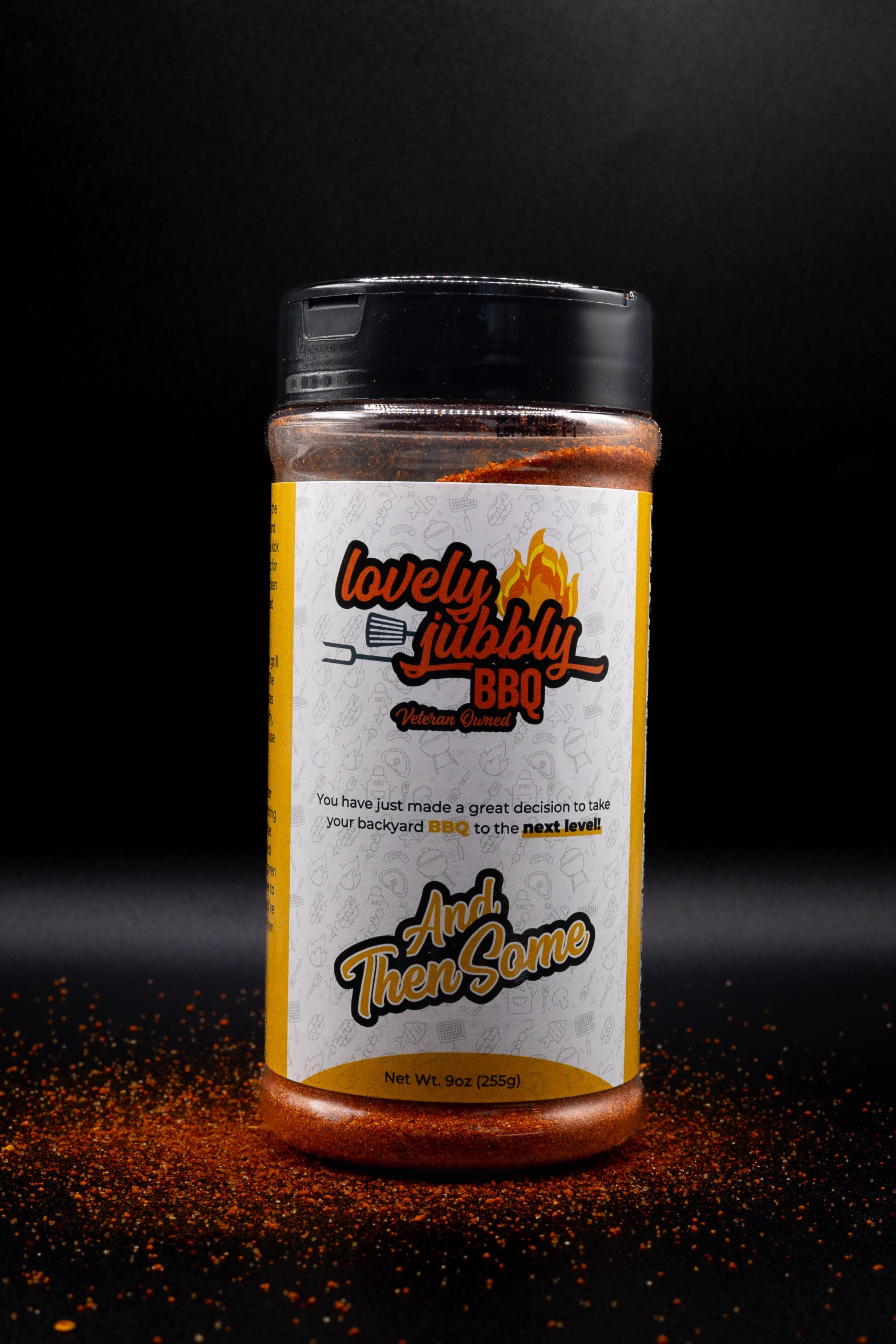
  • The And Then Some BBQ rub
  • Duck fat, or any other form of fatty oil

Recipe:

  • Place the turkey in the brine and give yourself 48 hours for it to sit in the fridge.
  • Once the 48 hours is complete, remove turkey from the brine, do not rinse.
  • Pat the skin dry and place in fridge uncovered for 1 hour
  • Remove from the fridge after 1 hour, coat the turkey in the oil and liberally apply the rub to the entire turkey
  • Set smoker to 300 degrees and place turkey on the pit.
  • After an hour, re-oil the outside of the turkey and turn it around to even out the heat exposure
  • Once the breast reaches 160 degrees internally, pull the turkey off to rest.
  • Serve hot, but make sure the turkey is above 140 degrees internal before eating, for food safety.

Find the And Then Some, along with many other BBQ tools and equipment at http://www.lovelyjubblybbq.com today!

As always, keep cookin’ and Lovely Jubbly!
(Pork) Butt Stuff

After a small hiatus dealing with the online store opening, and the busy holiday season, we are back with another weeks blog post. This week is about the ever popular pork butt, and my favorite dish from it, pulled pork.

The pork butt, contrary to what the name might suggest, is actually nowhere near the hind end of a pig. The pork butt is part of the whole pork shoulder which is made up of two specific parts, The Boston Butt, and the picnic shoulder. To competition cooks, there is a third part which is the pork collar, or the “money muscle” which is a section of meat opposite the blade bone. It got its nickname “money muscle” because if you cook it perfectly, it’ll make you money. The reason that the butt has its name despite not being anywhere near it is that in New England back in colonial times the less desirable cuts of pork would be thrown in a container labeled “butts” and the name stuck.

The typical butt is anywhere from 7-10 pounds and can come boneless or bone-in. For me personally, there are 2 things in BBQ that are more satisfying than anything else, a clean pull of the membrane off the back of a rack of ribs, and a clean bone being pulled out of a butt when fully cooked. With that, you can tell which one I prefer, the bone-in. Typically the butt has a small fat cap on the top of it and before I start layering rubs, I will usually score the fat cap because rub will not penetrate fat, and it allows rub to get down into the meat a bit as well.

Roughly an hour before I’m ready to put the butt on, I will pull it out of the fridge and let it sit on the counter to try and warm it up a little bit. 30 minutes later I will unwrap it, score that fat cap I mentioned and apply a light, but even layer of The Everything all purpose rub. At this point I get my desired smoker fired up to 250 degrees and after 15 minutes, I will apply the And Then Some rub to the entire butt and coat it completely. With the red qualities within the And Then Some, you can really see if you miss any spots as you are going around. You may have noticed that I did not say anything about putting a binder on before adding the first rub layer, and there’s a reason for that. I use the salt in The Everything in order to draw out some moisture, or “meat sweat” from the meat in order to use that as a binder for the And Then Some, which then it is just meat and rub. Personal preference is everything so if you like using a binder, then please do.

Some people like to cook the butt in an aluminum pan, and others will just put it directly on the grate. I have done both and the only difference I have noticed is that if cooked in a pan the entire time, there is a lot less clean up. Once the internal temp hits 165 and I am happy with the color on it, I will at this point put it in an aluminum pan if not already. Then I put a layer of brown sugar on the top of the meat just to make it sweeter when its all done, and then cover it completely in foil to help it get tender. I usually do not add any liquid in the wrap because as more and more fat renders, that gives plenty of moisture. If you would like to add some fruit juice to the wrap, then by all means.

Once the internal temp hits around 195, I will use my Inkbird instant read thermometer to check for probe tenderness. Probe tenderness is when the temp probe goes into the meat with little to no resistance, like a hot knife through butter across the entire piece of meat. Sometimes it will be done at the 195, sometimes 202, or even 205. Every piece of meat is different and bigger cuts like a butt or brisket will tell you when they are done. You always want to make sure you cook to temp and not time, especially since butts can take anywhere from 10-20 depending on your cooking temp. My rule of thumb if you are wanting to schedule a cook time is 60 minutes per pound of meat, plus 3 hours, and 2 hours rest. This means that an 8 pound but could be done in 8 hours, but give yourself 11 for it to cook, and then add 2 more hours for it to rest. 30 minutes can be a good rest if you are in a pinch, but more time is always better. Don’t pull the butt until after its rested, this will allow the juices to soak back into the meat. I will often rest my bigger cuts of meat by setting my oven temp to its lowest setting, 170 degrees, and after sitting out for about 30 minutes to stop the cooking process, I will leave it in the oven to hold and stay at temp without getting into the unsafe temp zone.

As I said before, few things in BBQ are more satisfying than pulling the bone out of the butt when its done and after its rested is exactly when you finally get to do that. Lots of people use claws when pulling the meat, and I have some in my store if you would like to get some! I use a pair of cotton glove liners underneath nitrile gloves and pull it by hand. I find it easier to break pieces down even further and be able to separate any fat that may not have rendered. See the full recipe below.

Ingredients:

  1. 1, 8-10 pound Boston Butt
  2. The Everything all purpose BBQ rub
  3. And Then Some BBQ rub

Recipe:

1. Trim the butt, getting the hard/ sinew fat off but leaving some fat to render down.

2. Score the remaining fat cap

3. Apply a light but even coat of The Everything rub

4. Set smoker to 250 degrees while The Everything is setting

5. After 15 minutes, apply a good coating of the And Then Some rub to all sides, cover all the exposed pork. 

6. Once smoker is ready, place the butt in the smoker and let run to 165 degrees, or until the color is where you like it.  

7. Once 160-165 is reached, pull the butt and place in a deep aluminum pan, cover the top of the butt in brown sugar and wrap completely with aluminum foil.

8. Place back on smoker until it hits about 195 degrees and then start periodically check for “probe tenderness” (probe sliding in and out of the meat like a knife through butter)

9. Once probe tender is achieved, take the tray off the pit and leave the foil on. Grab a big towel and cover, leaving it on the counter, or safe place.

10. If the internal temp falls below 140 degrees before serving time, place it in the oven at 250-300 until the temp comes up above 140. This is for food safety.

11. Once its serving time, drain most of the juice out from the pan, leaving some in to keep moisture among the meat, then pull it apart completely. Drizzle in a small amount of BBQ sauce (optional), toss, and serve.

Remember to check out lovelyjubblybbq.com for the rubs and any other products mentioned this week. We are also in store at Ava’s a posh boutique in Watertown, WI! Tune in next week for my Thanksgiving Turkey review.

As always, keep cookin’, Happy Thanksgiving, and Lovely Jubbly!

The Rubs Are Here!!!!!

I mean, there’s no other way to say it other than what I already said!

If you haven’t heard the news, the rubs are live and on sale! There’s 2 options currently, there is The Everything, and the And Then Some. Just for some background, I have been working on these rub recipes for about 3 years and once I knew I had a recipe that was worth it, that’s when I pulled the trigger.

So here is the process. As I’ve mentioned before, my love for BBQ started during Covid era and I have always been someone who likes to see what I can do to make a new hobby a bit more personal, so that’s when I started creating. There are a lot of good rubs on the market by a lot of fantastic companies and throughout my process of developing a good rub, I realized with my final recipes that I think I can compete with these other teams and be just as good.

I was told about a commercial kitchen in Watertown, WI that is able to be rented by food businesses that wanted an affordable place to produce their products and I was working on my food safe certifications. At the time I was working for a pest control company and as I was working in Watertown I happened to randomly drive by a company called JCB Flavors so I looked up their website and discovered that they do co-packing for companies and the light bulb went off. I reached out and told them all of the details. I signed my paperwork, gave them my recipe and the process was underway.

JCB Flavors has been a great company to work with and within a couple weeks of that first meeting I received notice that my first sample was ready for pickup. SWEET!!! A reason to BBQ, (not that I need one) but yay! So the first samples were very good but the And Then Some ended up being a little spicier than I wanted so it was back to the drawing board. The Everything was perfect from the first sample and we left that one as it was. The second sample came and when I took the first bite, my tastebuds danced; this was it, a star was born.

From there became the daunting task of finding a graphic designer to make the labels. I found someone and there were many problems with her that ended up causing me to lose interest in the project for a little while, on top of buying a home, a job change, and some medical issues all within the same time frame, so the rubs went on the back burner.

Last fall I was finally ready to get back to it and got in touch with JCB and my label company, Belmark know that this was finally going to happen. Once we had label approvals, the orders were placed in August this year. Now we end up where we are today where the rubs are on sale and ready for you to enjoy, and right before Christmas!!

Here’s what we have to offer. The Everything is an all-purpose seasoning that is good on its own, or paired with the And Then Some. It is great for beef, pork, chicken, seafood, potatoes, and literally EVERYTHING you can imagine! The And Then Some is perfect especially on pork and chicken, but has a great balance of sweet and savory that it will also work very well on anything you want, and give it a great color too. Another beef specific rub is on its way soon and then we will see where the path takes us!

Find our rubs at lovelyjubblybbq.com or exclusively on sale in store at Ava’s a posh boutique at 209 E Main St, Watertown, WI 53094.

As always, keep cookin’, and Lovely Jubbly!

Mini BBQ Meatloaf

This week I tried to take a classic comfort food and give it a little modern BBQ twist. Meatloaf has been a staple of American cuisine since the great depression and most of the time it is a large, dense, and thick slice of meat, typically ground beef, but everything is open to interpretation these days.

I was going to make a typical meatloaf with 1 pound of ground beef and 1.25 pounds of ground pork, put it on the smoker and have it for dinner one night, but we ended up making plans with family so I decided to see what I could do to switch it up and make it last with more people. Normally I would use even amount of ground meat, so a 50/50 ratio, but in this instance, this is what I get for not reading labels until I got home. You can absolutely use any types of ground meat you want, just try and keep the combination ratio as even as possible.

As most of us know, meatloaf is a formed by using ketchup and bread crumbs to help the loaf stay together. Since I was making BBQ meatloaf, I decided to use BBQ sauce instead. This was great because I still got the same effect of the sauce acting as a binder, but then it added another layer of flavor. You will often see diced onion and garlic in a meatloaf as well, but I decided to omit those simply because with how small these were, I didn’t want the diced onion and garlic to take over as the primary flavor instead of the meat.

In a large mixing bowl, I added both ground meats, the BBQ sauce, and my prototype beef rub and mixed thoroughly with my hands. I grabbed a 9 cup muffin pan and place a small meatball in each cup and then with my fingers, I pushed the meat down into the cup and formed the meat into a cup of its own. Here’s where it got fun, I added 2 small Colby Jack cheese cubes into each meat cup, as seen below. I like adding the cheese because it adds some more flavor, and I live in Wisconsin, so everything needs cheese. The muffin pan is great because it offers a good way to form the meat, but there are mini loaf pans as well if you would prefer a smaller version of the traditional loaf look.

I ended up starting to cover them up before I got the photo, so I apologize for that, but you get the gist.

With the leftover meat in the mixing bowl, I formed little lids for each mini loaf to enclose it. Once I had them all covered up and sealed, I used a butter knife to loosen them up within the muffin cups and tipped them out on to some prepared aluminum foil on a large baking sheet. At this time, I gave them a another sprinkle of rub over the top and I got my Pit Boss Sportsman 1100 all set up and set to 250 degrees with my favorite Lumber Jack competition blend pellets.

I let the mini loaves sit on the smoker for about 45-50 minutes undisturbed and finally temp checked them with my Inkbird Instant read thermometer and they were at about 153 degrees internal. I wanted them to at least be at 160 degrees internal before I pulled them off. Right about the 60 minute mark they hit where I wanted and I pulled them off. Thankfully they had a nice long rest because of the 40 minute drive to my moms house.

I do want to emphasize something, They lost a lot of the heat on the drive. I put these back in the oven to warm them up once we arrived in order to bring the internal temp about 140 degrees. All cooked food should be above 140 degrees internal for food safety reasons. Bacteria can grow rapidly once they get under 140, and keeping them above 140 kills the bacteria and the food is safe to eat.

The great thing about this recipe, and the next few that I am going to do is that it also makes a perfect party food. They do not take long to prepare, they are small enough to fit on a plate with other foods, and you can eat them in 2-3 bites.

Ingredients:

  • 1 Pound Ground Beef
  • 1 Pound Ground Pork
  • 2 Tbsp BBQ sauce
  • 2 Tbsp your choice BBQ Rub.
  • 8 oz Colby Jack Cheese Cubes (optional)

Recipe:

  • In a medium/ large mixing bowl, add both meats, BBQ rub, and BBQ sauce and mix thoroughly.
  • Spray muffin or loaf pan with cooking oil and place a meatball in the cup. Then push the meat to form fit the muffin cup, leaving a well in the middle.
  • Add the cheese cubes to the well in the middle of the loaves and use the remaining meat to close the meat loaves together. Place loaves on a baking sheet.
  • Prepare smoker to 250 degrees with your choice of wood or pellet flavor.
  • Place baking sheet on the smoker and watch until they hit about 160 degrees internal.
  • Let rest, and serve with your favorite meat loaf sides.

As always, keep cookin’ and Lovely Jubbly!
Gadgets and Gizmos Aplenty

This week I am going to take a slightly different approach and talk about my equipment that I use in both competing and cooking at home.

To start, I am going to talk about my smokers. I have my Masterbuilt 1050 Gravity Series Charcoal Vertical Smoker. I saw this online a few years ago and my first thought was “this would be a great rib cooker” as I was right. It runs on charcoal and wood chunks and holds temp like an absolute tank. It is ran by a small electric fan that helps keep the temperature exactly where you want it to be. I use it at competitions as well because consistency is key when cooking competition BBQ and this smoker does exactly that.

I also have 2 Pit Boss pellet grills, the Classic, and the Sportsman 1100. They both operate the same, load with pellets and set and forget. The Classic has 700 sq in of cooking space and it was the first smoker/ grill I bought for myself that started the landslide into what I have going on now. I usually use the Classic for my competition chicken because the constant air movement in the cooking chamber is great for rendering fat. The Sportsman 1100 got its name because it has exactly 1600 sq inches of cooking space (I know, I don’t get it either). The bigger cooker is my primary for pork butts, especially overnight because I can set the temp, put the butts on and go to bed, knowing full well that I have nothing to worry about.

I have 2 trusty Weber 22′ kettles. I keep one, the Performer, which is the kettle attached to a cart which is very handy for moving around, I keep that one in the competition trailer for cooking lunch and now steak competition cooks. I have another Weber, which I actually bought from my dad a few years ago and since then, I have burned through the cooking grate on it and it is losing paint within the lid because I use it so much at home.

One of the new acquisitions of mine is the Oklahoma Joe’s Bronco drum smoker. I have always wanted a drum and the price point was good enough on it that i finally pulled the trigger this summer. Drum cookers are very popular on the competition circuit and just as popular for backyard cooks because they run on charcoal/ wood and air flow, that’s it. What’s cool about my drum is that I was able to get it in orange, which goes with my team/ company colors.

Finally, I have my newest smoker that I picked up right before this last competition and it is my Old Country BBQ Pits G2 insulated offset smoker. I talked about this, along with the competition trailer in my summary of the Adams Rib Rib & Steak Challenge post last week. My Hog roaster that I bought this year as well is covered in my The Whole Hog post.

Other tools I have are my Inkbird instant read thermometer, which I have had for almost 4 years now and it has been one of my favorite cooking tools I have ever had. It has never lost calibration in that time, and it has a rechargeable battery that last for a very long time. I also have my Vortex cone which is great for wings, and using a a heat sync for indirect cooking on the Weber. More on the Vortex in my Chicken!! post. I also have a Govee Home 4 probe WI-FI thermometer that I found on Amazon that really works quite well. It gives me piece of mind knowing that I can set the desired temp for the meat and it will let me know when it gets to that temp and I don’t have to open the lid as much.

Lets talk charcoal now. I have really come to enjoy Blues Hog charcoal briquettes because they are bigger and burn longer. I also enjoy Royal Oak Lump Charcoal as well. Pellets wise I enjoy Lumberjack Competition blend which is a blend of Cherry, Hickory and Maple, it adds great flavor and smells even better while cooking. To light my fires, I use Royal Oak Tumbleweed fire starters on a charcoal chimney to start the charcoal, and Masterbuilt fire starter blocks for lighting the Masterbuilt because they were specially made for these types of cookers.

Adams Rib Rib & Steak Challenge

This past weekend we competed in the Adams Rib Rib & Steak Challenge in Van Dyne, WI. As the title suggests, it was a double rib turn in and a steak competition and made for a very busy day.

The Lovely Jubbly BBQ Competition Team consists of myself, Mitch, My wife Dani, our daughter Ellie (a rib eating machine) along with my dad Mick and his girlfriend Kelly. Between the 5 of us, we make a pretty efficient team that has a lot of fun mixed in. We did something different this weekend that is going to replace photos for this week’s blog post. We filmed as much of the day as possible, and it will be posted on the Lovely Jubbly BBQ Facebook page once the editing is complete.

This competition was the inaugural competition for both the new Lovely Jubbly Mobile (my new competition trailer) and our new Old Country BBQ Pits G2 insulated offset smoker. The trailer is a fantastic addition to our competition setup. Having the storage is great, being able to make a more permanent setup is even better and we don’t have to unload it and return it to U-Haul when we are finished with it. Cleaning up after a comp is so much easier when we only have to pull out what needs to be cleaned, and then put it back and ready for the next time. Plus, it was very windy at this competition, so having a workspace that was out of the wind was a huge benefit. The smoker is insulated and is a tank. It was a lot of fun learning to work with it while actually competing. As i mentioned before, It was very windy, so even the insulated firebox was struggling in the 20-30mph winds, but we made due and made some awesome ribs on it.

Given that it was a double rib competition, I wanted 4 racks of spare ribs, 2 per turn in to give myself enough ribs to choose from, and I tried something different this time as far as brand and where I sourced them from. These ribs were Prairie Fresh Prime Spare Ribs and this was the first time I had used them. I am familiar with Prairie Fresh from using their Naturals line of products, usually from Walmart, but I had heard of the Primes and decided that this level of competition was the perfect place to try some high quality meat. I found them at Piggly Wiggly in Milton and was able to order them through the meat department. Each rack had great marbling (fat interwoven throughout the meat) and each rack was 4-5 pounds each, where the Naturals are usually anywhere from 2.5-4 pounds per rack, so more meat.

The steaks were provided by the event organizer and the 3 choices for steak cuts were Ribeye, NY Strip, and Tenderloin. For steak selection, each team was called randomly to grab a box of 2 steaks without looking at them, I ended up grabbing a box with NY Strips in it, which I was perfectly fine with because it is my favorite cut. Most people like Ribeye’s, and I like them too, but the more people that order Ribeye’s, are less people taking my NY Strips ;).

The process started Friday afternoon as we set up the trailer and got everything ready to go for Saturday. 4:30 Saturday morning we got up and hit the road for the 90 minute drive to Van Dyne. Once we arrived at our site, we set the trailer up, got the fire started to preheat the smoker and set the site up. About 8:15 we trimmed the ribs from full spares down to St Louis style, removed the membranes and got the first set of ribs rubbed with The Everything seasoning and let it set for 15 minutes. The And Then Some went on about 8:45ish and rested till just before 9 when I had to go to the cooks meeting, so the first 2 racks were put on. The same process started at 9 for the second turn in.

Once the ribs were on, we were able to socialize for a little while, see some fellow BBQ friends that were there and make some new friends as well. My ribs process for this competition is the same as my normal process, so instead of repeating the entire process, please see my “RIBS! RIBS! RIBS!” post from 9/16.

Steak turn in started at 12 and ended at 12:30, so we started cooking the steaks about 11:40ish and put the grill grate on top of the hot charcoal chimney in order to get a nice sear on the outside, and then rest before turning in. The requirement for the steak cook was a supper club steak, and cooked the way we would want to eat a steak, so we went with the one we liked best to turn in, and then chowed down on the other one that was left behind. We got our steak turned in almost right away in the window, and then shared leftovers with our surrounding teams, like they did to us.

Once we worked through the rib cook, the first Rib turn in window was 1-130 and I decided to do a Hollywood cut on these ribs. A Hollywood cut is cutting out a rib by skipping a bone so it maximizes the meat on a single rib bone, giving as much meat per bone to each judge as possible. I can admit that I was not as pleased with this turn in as I was hoping to be, but we made it on time and got 6 bones turned in as required, so you can’t ask for much more. The second turn in window was 2-2:30 and I was very pleased with this box, you’ll find out soon why it’s an ironic statement.

After getting everything cleaned up we went in for awards. Top 10 in Steak got a call, and the top 5 got a check, along with a medal. Top 10 in Ribs got calls and checks, along with medals, and the top 2 of each got trophies. In total, the results for us weren’t the best, but like I said, we made each turn in on time and despite the troubles with the wind, I couldn’t ask for more.

Our results were:

  • Steak: 18th of 23 teams.
  • Rib A: 21st out of 31 teams.
  • Rib B: 31st out of 31 teams.

Like I said, I was not proud of my first rib box, but we clearly faired better with that box than we did the second box, hence the irony. It has been said before though, if you don’t like your turn in, chances are the judges will, and vice versa.

This will probably be our last competition for 2024, but I am already looking at planning for at least 5 next year already. More to come with that as they get closer.

As always, Keep Cookin’ and Lovely Jubbly!

My Favorite Fall Recipe

This week is all about my favorite fall meal, chili! I know its 80 degrees outside, but tomorrow is the first day of October and fall is definitely on its way. I made this for a family football party we had for the Packers- Vikings game, an annual tradition for our family and it always goes better when my Vikings win. SKOL Vikings!

Like I try to do with every recipe, I try to make it my own, which I will encourage you all to do, and chili is no exception. You will typically see some sort of ground meat in there and beans are always controversial. I make mine by taking a chuck roast, smoking it, and then chopping it up to put in the chili. I personally like beans in my chili, but to each their own.

The chuck roast comes from the front shoulder of the cow and usually has really good marbling, and as we all know, fat means flavor. The chuck roast’s are usually 204 pounds and is often called the “Poor Man’s Brisket” because it has a similar flavor profile and marbling to a brisket but not as tender, but exceptions always apply. I got this roast from Walmart, which is controversial as well, but I personally have always had good luck with Walmart meat and will stand by it.

I use my beef rub, which is in the R&D phase right now, and apply a good layer of the rub to the chuck roast and let it sit for a while. While it is sitting, I’ll fire up the smoker. This time I decided to use my Oklahoma Joe’s Bronco Drum Smoker with some Hickory wood chunks. I get the drum dialed in to 250 degrees and put the roast on. I have the ThermoPro Twin Spike wireless temperature probe and put one of these in the roast. The nice thing about these probes is that not only does it monitor the temp of the meat, but it also has an ambient temp monitor as well so I can monitor the temp of the smoker without having to babysit it all day.

A chuck roast will usually take about 6-8 hours at 250 and usually an hour rest will help it retain moisture. Once the roast hit 160 degrees internal I wrapped it in butcher paper until it was probe tender, which for this roast was about 199. After I wrapped it, I got the Dutch oven started and got the chili started so the spices and ingredients can meld and stew. In my chili, I start with olive oil, minced garlic and diced yellow onion and let them get aromatic. Then I add tomato sauce, a large tomato soup can, and spices like chili powder, cumin, and cayenne pepper, oregano, and salt. I let these simmer until the chuck roast is done and rested. At that point I will chop up the chuck roast and add it to the chili pot. I then rinse a can of pinto beans and a can of kidney beans, add them to the pot and let it all sit and built flavor.

You might have guessed by now, but I like my chili with a bit of a kick, and I like it thicker. If you like it thinner, you can add some beef broth, a little at a time, until it at your desired thickness, and you can adjust the cayenne more or less based on the amount of heat you like, or don’t like.

The full recipe is posted below.

Ingredients:

  • 3-4 Pound Chuck Roast
  • Your Favorite Beef Rub
  • 2 cloves of garlic, finely chopped or minced
  • 1/2 cup yellow onion, finely diced
  • 2- 8oz cans tomato sauce
  • 23oz can condensed Tomato Soup, aka family size
  • 2 tbsp olive oil
  • 2 tbsp chili powder
  • 1 tsp ground cumin
  • 1 tsp ground oregano
  • 1 tsp salt
  • 1/4 cayenne pepper
  • 15oz can kidney beans, light or dark (optional)
  • 15oz can pinto beans (optional)

Directions-

  • Coat chuck roast in your favorite beef rub
  • Let meat rest, set up smoker for 250 and use favorite choice of wood
  • Add roast to the smoker and cook to 160 degrees internal
  • Once the roast hits 160, wrap in butcher paper or aluminum foil and continue cooking on the smoker
  • After wrapping the roast, add olive oil, garlic, and onion to a pot and cook until aromatic.
  • Add tomato soup, tomato sauce, and spices and let simmer until chuck roast is rested.
  • Once chuck roast hits 200 degrees internal and is probe tender, pull off the smoker and rest in the butcher paper, and placed in a dry cooler for at least an hour.
  • Once roast is rested, chop it up and add to the chili pot, stir.
  • Rinse the pinto and kidney beans, and add to the pot, stir again.
  • Once beans cook for about 10-15 minutes, the chili is ready, serve, and add any fixings that you prefer.

This weekend we have the Adams Rib Rib & Steak BBQ double rib and steak competition in Van Dyne, WI. Tune into the Lovely Jubbly BBQ Facebook page for updates throughout the day, and competition summary in next weeks blog!

As always, keep cookin’ and Lovely Jubbly!
October’s Wing Recipe

The very first wing recipe of the month is here! I thought I would start it out with a recipe that I really enjoy is opposed to starting off with a basic buffalo chicken wing. October’s wing of the month recipe is, Garlic Parmesan!

I love garlic parmesan wings. I love garlic, I love the saltiness of the parmesan cheese and the tanginess of the sauce. There are many ways to make this recipe, one being the first attempt I made, but the sauce was terrible so that’s never happening again. This was take 2 and you can tell I like it because I’m sharing it with you. This post is going to be short and sweet so we can focus on the recipe itself.

First, I started off with whole Perdue chicken wings. I like buying whole wings because I can break them down to the flat and drum, and in my experience, doing that leaves you wing a bigger wing piece. To break them down, I find where the bones of the drum and flat meet and on the flat side of that bone intersection is a tendon that allows you to cut straight through very easily. Then remove the wing tip from the flat and you have your 2 wing parts.

I then put them on a sheet pan with a wire rack and put them in the fridge for about an hour, allowing the moving air within the fridge to help dry the wings off, helping make crispy skin while cooking. While they were in the fridge I got the charcoal fired up. If you saw my Chicken post a few days ago, you’ll see that I love my Vortex grill attachment for my Weber 22″ Kettle.

After an hour, I pulled the wings out of the fridge and seasoned them with my “The Everything” all-purpose rubs and put them on the grill. I put a couple small pieces of hickory wood in the center of the Vortex and put the lid back on and let them cook.

While they were cooking, I made the sauce. Typically, wings are tossed in the sauce after cooking, but this sauce had a thicker consistency so I felt putting it in a squirt bottle and applying it to each wing was the better way to go. The full recipes are at the bottom.

Once the wings hit about 195-200 degrees internal, I pulled them off and let them rest for about 10 minutes, added the sauce and dug in. This sauce had such a great creaminess about it with great garlic and parmesan flavor, along with some other herbs and seasonings that added great balance. My wife even dipped chicken nuggets in it and loved it.

Wings Recipe

  • One pack of whole wings, or pre-trimmed flats and drums.
  • The Everything- all purpose seasonings, or your favorite all purpose type seasoning

Trim the wings down to drum and flat if needed

Place the wings on a wire rack and put them in the fridge for an hour uncovered.

Start your grill or smoker

Once an hour is up place them on the cooker until they hit at least 160 Degrees internal.

Sauce Recipe:

Ingredients:

  • 10 cloves of garlic, finely chopped
  • 1 cup mayonnaise, an oil based mayonnaise can add a smoother flavor
  • 1/2 cup buttermilk
  • 1/2 cup finely grated parmesan
  • 1 tablespoon Cajun seasoning, I used Tony Chachere Creole Seasoning
  • 1 tablespoon italian seasoning
  • 1 teaspoon granulated garlic, garlic powder will work too
  • 1 teaspoon granulated onion, onion powder will work
  • 1/2 teaspoon granulated sugar
  • 1/2 teaspoon kosher salt
  • 1/2 teaspoon finely ground black pepper
  • 1 teaspoon lemon juice

Combine all ingredients in a medium mixing bowl and place in the fridge until ready. This sauce will last in the fridge for up to a month as long as stored in an airtight container. I do not recommend freezing it.

Chicken!!

If you haven’t guessed yet, this week we are talking about chicken. Very versatile and always a winner, as long as it’s cooked properly!

Chicken basically defines the phrase “crowd pleaser” and can be cooked in so many different ways that you can do it every night for a month and do it differently every time. Even though there are so many options, I’m sticking with doing it on the grill/ smoker.

My favorite way to cook chicken is with my Vortex attachment for my Weber 22″ Kettle. *shown in the pictures* The Vortex is a metal half cone that helps with indirect cooking. What it does is you put the charcoal inside the vortex and it focuses the heat to the top of the lid and it then comes down the dome and cooks the meat. It is great for chicken wings especially, but it gives a good crunch on the skin without burning the meat.

The Vortex can also be turned upside down so the wide part of the cone is facing up, and you can lay charcoal around the Vortex as an indirect heat shield as well. I have a picture below of it being used in such a way. It really is great for more than just chicken, but we’ll get into those at another time.

So, what about cooking it? Chicken is one of those types of meat that is really finicky, and the white meat especially can dry out very quickly. The white meat, breasts and wings, are cooked once they hit 160 degrees in the center of the meat, dark meat is typically done at 170 degrees. It is very important that you get your chicken to AT LEAST the 160 degrees internally, chicken sick is nothing to mess around with and can cause Salmonella, Campylobacter, and Clostridium. I have no idea what those last two are, but if I can’t pronounce it, I don’t want it.

Also, and I have no idea why this is a thing, but please, for the love of God, do not rinse your chicken. You can spread so many germs and bacteria around your kitchen doing that and there’s absolutely no reason for it. There’s my PSA for the day, and hate and argue all you want, you will not change my mind.

Anyway, back to cooking. I personally use an Inkbird instant read thermometer to check all of my food, but any form of instant read thermometer will work in making sure that your chicken is cooked properly. Chicken breast are notorious for drying out, so I usually cook mine till about 160 degrees, and let the carry over during the rest bring it up to about 165 int. Rest it on a plate and loosely cover it in foil so it can vent and not keep cooking with the steam caught in the foil. Since breasts can dry out so easily, the rest is very important because it helps the meat soak in the juices and spread out throughout the meat. It is important with every cut of meat, but chicken especially because of the lack of fat.

My favorite part of the chicken is the thigh. I love dark meat in general, but the thigh has the most flavor and is typically juicier. Thighs are also the primary turn in for competition chicken as well, as shown below, some pictures of my competition thighs. The nice thing about chicken thighs is that they are very forgiving if you overcook them. I usually take my chicken thighs to about 200 degrees internal because you want an easy bite, and bite through chicken skin, which is very different from at home when you want crispy chicken I am also partial to the drumstick because it is also dark meat, but it also has a handle, and food with its own handle is always better.

To summarize this weeks post, use a thermometer when cooking your chicken so you know it’s done, overcooked chicken is not fun to eat, and undercooked chicken will haunt you. AND DON’T WASH YOUR CHICKEN!!

As usual, keep cookin’ and Lovely Jubbly!

Ribs! Ribs! Ribs!

This weeks blog is all about the mighty rib. I am going to offer my recipe up so you can go ahead and make the best ribs of your life, but warning, this recipe does get expensive because everyone will want them after trying them.

Who doesn’t love ribs, am I right? I have found that around our area of South Central/ South Eastern Wisconsin, baby backs are the rib of choice, which was once confirmed by my placing an order at a meat market for spare ribs and they called me back right away making sure I wanted spares and not baby backs because they don’t get many people asking for spares.

So what’s the difference? Great question! Baby backs are also called loin back ribs or back ribs and that is because they come from the rib section closer to the spine, which is where the loin is located. Baby backs typically have less meat on them, and the meat can dry out easily because that loin meat does not have a lot of fat compared to other cuts of the pig. Baby backs also have a signature curve in the bones because of how close to the spine they are. Spare ribs, my favorite rib of choice, come from lower on the rib cage and the meat on the spare rib is fattier because it comes from the belly. Since it is lower on the rib cage, the bones are straighter, which makes the racks typically bigger. When it comes to competitions, spare ribs are the most common ribs cooked because they are meatier, but in certain regions of the country you will see baby backs reigning supreme, typically down south.

I’ll get into this more on a future post, but in competitions, everything is different, and I have spent 3 years trying to perfect my rib recipe so I can try and have an edge while competing. Competitions are typically a one bite, blind judging challenge, so you want to try and pack as much flavor into that one bite as possible. I have finally found a recipe I am confident in, and the nice part is that it works for competitions, and backyard cooking as well.

I am going to explain my technique here, but I do plan on posting just the recipe itself in another section of the website once I get that set up.

I usually buy whole spare ribs, which can be bought at almost any store. Once i get them home, I will cut in a straight line from the biggest bone and completely cut the meaty flap without bones. This is called the St Louis cut or style, and some stores will have pre-trimmed St Louis Style Spare Ribs for sale as well, which is a great time saver. I like trimming my own and saving the meat for future cooks, or just throwing them on the smoker with the ribs and making rib tips. Once I have them trimmed down into perfect rectangles, I flip them over and remove the big flap of meat that goes along the back to even it out and make it flush. Then I remove the membrane, which is one of the most satisfying things in bbq, especially if you get it in one pull. I usually use a piece of paper towel to remove it, but they do a make a membrane removal tool, and you’ll often hear about getting a butter knife underneath it and using it to pull it up enough to get a finger underneath it, you pick what works best for you.

At this point, the ribs are ready for seasoning. I do a double rub and no binder, which is just a preference for me. I start with a light layer of The Everything all purpose rub of mine (available soon!) and coat the ribs evenly on both side. The Everything has a course grind of salt and pepper and once its on, it starts pulling moisture from the meat which after about 15 minutes, the “meat sweat” as I call it acts as a binder for the primary rub. Usually after the base layer is on, I take the time to get the smoker fired up and ready to go. I cook at 275 on my Masterbuilt 1050 Charcoal Vertical Smoker with Blues Hog Charcoal Briquettes and Cherry wood chunks. Use whatever wood flavor and charcoal you like, this is just what I prefer.

After 15 minutes, I apply the And Then Some rub (also available soon!) and I apply a good layer to both sides of the ribs, and the edges as well. The nice part about this rub is that the primary red color helps you know if you need to fill in any spots. Once the rub is on, I usually let them sit in the open air for about 15 minutes before putting them on. Letting them sit helps the rub set and adhere to the meat better. At this point I’ll get them on the smoker and sit there undisturbed for an hour.

After an hour, I will spritz them with Apple juice. The apple juice helps keep the exterior of the ribs from drying out and keeps moisture on the rub. The sugars in the juice helps give a great color and some caramelization on the outside as well. 30 minutes later I will spritz again. After 2 hours on the pit, I pull them off and get ready to wrap. The base layer on the wrap is lined with brown sugar, honey, a few pats of butter, a shake of the And Then Some rub, and a good few sprays of the apple juice again. At that point I put a rack of ribs meat side down on that layer of ingredients so you are looking at the bottom of the ribs, then repeat those same ingredients on the back side of the ribs as well, do this same process with every rack. Once each rack is done, put them on them back on the smoker for about 90 minutes.

After 90 minutes, use a thermometer and check the temp between bones, if the temp is between 202-207 degrees pull them off, if not, keep them on checking periodically until you get between that temperature window. Once they are pulled off, drain the liquid out of the wrap but keep the ribs wrapped and rest in a dry cooler for about 30 minutes. After 30 minutes, pull them out of the wrap, sauce the ribs and put them back on the smoker for about 5-10 minutes until the sauce is set and somewhat tacky.

A great tip for cutting the ribs is to put some sauce on the cutting board before putting the ribs down and put them meat side down. The board sauce helps the ribs not stick to the board, and ruin the top of the ribs. By cutting them meat side down, it is easier to see the bones so you can cut more accurately. The next step is very important, EAT!

This will be posted to my Lovely Jubbly BBQ Facebook page and if you have any questions, feel free to comment on the post and get the conversation started! Remember, there are many ways to cook ribs, this is my way, there are no right or wrong ways to make ribs, unless you boil them…

As always, keep cooking, and Lovely Jubbly!